Wednesday, 3 November 2010

Reflective Writing..


I chose yesterday to test out Reid and Moons frame work when writing a journal entry. I chose this day as there were a number of events happening.
I first had a rehearsal for the show I am involved with, it was just for me to meet the actors, watch them run the first act and see the set as dancers don’t start until next week.
Secondly I had a meeting with a company I teach for about a possible summer project I would like to get involved in.
Thirdly I was teaching at dance school; four separate classes for children between the ages of 4 and 16.

I have decided not to write out my full description of the day on here as it is very long but just to go through some of the points bought up when using the framework. It was easy enough to write a description of the day’s events in detail as it was still very fresh in my mind. Without realising it I did some reflecting as I was writing my description adding in things that had gone well or hadn’t and how I felt. But it further helped my reflection when I went through the questions

What did you feel about it?
I felt I had had a really good day, but didn’t realise I thought this until prompted with the actual question! It was constructive and I was able to cover three important areas of work. I was up and out of the house early which made me feel like I was making the most of my day and time.

What were you thinking?
After rehearsals I was thinking I am happy to be involved and looking forward to doing the shows. But it also made me realise there are some areas I am concerned about, I have done it before and it always works out in the end but I can’t stop myself from worrying!

Did anything unexpected happen?
I hadn’t thought of looking at any events as unexpected but there were two that came to mind when asked this question.
1.      A new song has been added to the show, so that means more choreography for me.
2.      When teaching I had not planned to do creative sessions but the children lead me in that direction with a fireworks theme and it produced some really great results.

What was your mood?
I was generally in a good, happy, positive mood. There were a few tired moments when teaching though.

When asked to make a list I admit I was a bit hesitant about how this would help me reflect as surely I had just covered everything I had seen, felt and done in my description of the day!?
However I really enjoyed making a list of just one word answers about the day and guess what, it turns out it made me think in a different way and I came up with some events and feeling I hadn’t even thought of earlier.

Colourful Set
Scripts
Rain
Music
Hot and Sweaty
Manic
Fireworks
Bang
Explosion
Travel
Welsh
Excited
Confused
Happy
Proud

I could easily see what had gone well during the day and what hadn’t. But did I learn anything? Yes! 
  • I am not a morning person and so need to prepare items for a busy the day the night before instead of trying to rush around in the morning and find them all!
  • I actually discovered I am better at thinking on my feet than I had thought. During my meeting I was put on the spot and able to come up with good suggestions on how we could work with different age groups and get as many people involved in the Musical show as possible. Then when teaching when I realised the children would really enjoy a creative class I was able to quickly find some suitable fireworks music, give clear instructions and guidance on a task I had never done before, and set up a structure in which to present their work at the end.

It was interesting looking at the day from someone else’s perspective and is something I will try to do more of in the future. I think we can easily get wrapped up in our own little world of thoughts and feelings, and this just helps to see things through other people’s eyes.

When looking at the day as a whole and trying to see how it fits in in my daily life and perhaps with this course it made me think that I am very lucky to have such varied job, and work with some amazingly talented people. I also get to pass my knowledge and experience on to children who share my passion for dance, and I do feel proud of both them and myself when we have had a really productive class.

Monday, 1 November 2010

Journal Writing.

There have been two previous times in my life that I have kept a journal. One was as a child when we went on our summer holidays to Portugal I would keep a record of what I had done every day, which pretty much consisted of; woke up, ate breakfast, played with toys, went for a swim, ate lunch, watched TV, ate dinner, went to bed. My life was very exciting!!
I actually found that journal not that long ago and my sisters and I had a good laugh over reading it, the only things I really went in to detail about was the variety of food and whether I liked it or not!

The second time (which I was hesitant to talk about on here) was last year when my mum was involved in a car accident and was killed. I started to record experiences I had had with her. I felt they needed to be out down on paper as I didn’t want to forget anything. I didn’t want to reflect on them right then but I knew they would be there in black and white for me to look at in the future.
I also used it as a form of therapy. I found it easier to express how I felt by writing it down than by saying it out loud. I could be honest and open and not hide anything. I used it as a way of understanding my thoughts, feelings and emotions. As Jenifer A Moon suggests a journal can be used “To provide an alternative `voice’ for those not good at expressing themselves” (Moon 1999a, pp. 188–194)


I love how Miranda Tufnell and Chris Crickmay describe the importance of being engaged with reflection “In the rush and pressure of our everyday lives we easily become numbed, cut off from our bodies” (Tufnell and Crickmay, 2004) 
Life happens so quickly and we are always looking forward to the next thing that sometimes we forget to take the time to look back. Whatever form your reflection takes, be it talking, drawing, writing, or thinking, it is important for us all to take the time to do this. We need to know where we have come from in order to know where we want to go next. I believe reflection is an important tool not only in studying but in life.

Reflection is going to play a big part for me in this course and with what I want to do next. Over the last few years I have enjoyed performing and teaching dance but am unsure what direction I want to go in the future. Reflecting on what I have done, what makes me happy, what makes me passionate and enthusiastic and what I don’t enjoy so much will really help me move forward and find my next step.

Sunday, 31 October 2010

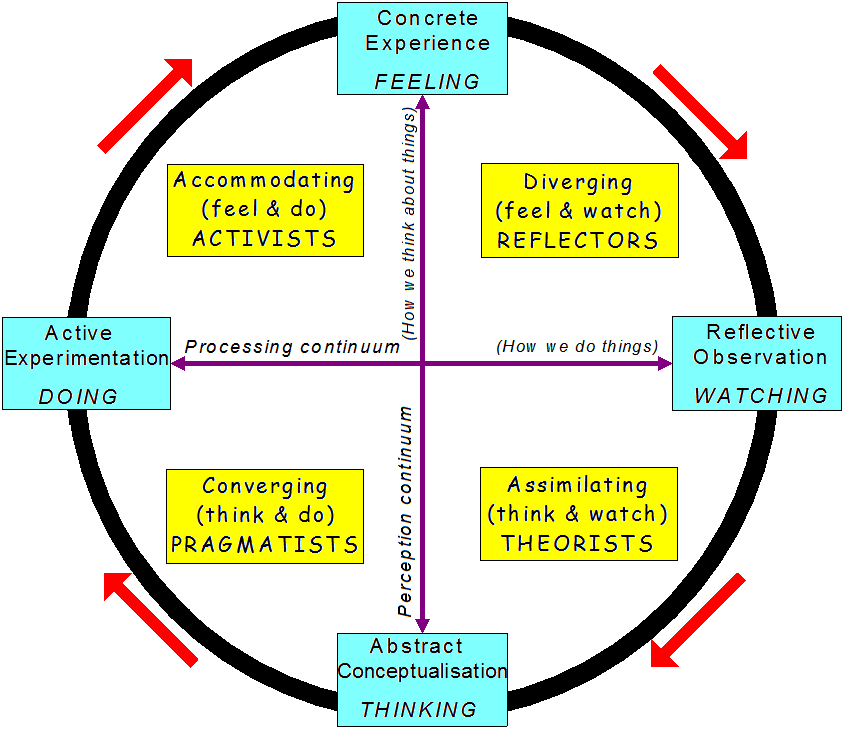
Kolbs Learning Cycle

I found the theory behind Kolbs learning cycle very interesting, and whilst able to see immediately where I fitted in with regards to uploading my blog (Reflective Observation), I found myself thinking about other situations and whether this was true of me always. I also tested it out on some other people to see if they could identify where they fitted into the cycle, and more often than not they pointed to more than one stage on the cycle. It can be hard as Adesola  says in the Reader we all do all of these things; it’s just working out what our preferred way of learning is and where it is that we actually start to learn something new.

Having researched into it a little more, I found that Kolbs cycle goes in to further detail about our learning. As well as the four learning stages it can be divided into four quarterly sections. Each section combines two of your preferred learning stages in order to give you your learning style. This really clicked with me and i could now see much clearer where I fitted into the cycle.

I am a Diverger, i learn through feeling and watching. A typical diverger is able to look at things from different perspectives. They prefer to watch rather than do first and use their imagination to solve problems.
Maybe the below cycle will help you figure out where you fit in!


Wednesday, 27 October 2010

Reflection In Action

Having made a start on the Reader, and following Rosemary’s link to read Marks blog on ‘Reflection IN and ON Action’ it has really got my thinking about the idea of reflection in action and out of action reflection.
I agree that as a dancer we have to be reflecting in action as we dance in order to stay on top of our performance with delivering precise steps, energy levels, balance, musicality, performance and spacing. But I began to wonder, what is the difference between reflecting in action and just reacting to what is happening? Do we really have time to reflect mid performance?
For example what if during the middle of a performance a fellow cast member does not make it on stage and you have to adapt to the change of situation: say you have to change spacing, cover their steps or even leave the stage as you are partnered with them. Is this reflection in action or is it just reacting to the changes you are presented with.
After giving it some thought I have come to believe that reflection in action is a learnt skill. Without realising it as dancer’s reflection in action is something we have learnt and improved on perhaps since the day we started dancing. It can happen so quickly that sometimes we probably don’t even recognise the process. This brings me to the conclusion that reflection in action is the thought process which in turn leads to a physical reaction where by you change something as you are doing it. You need reflection in action in order to prompt the reaction.

Could it also be said that you can do both reflection in action and reflection on action for the same event/experience. When reflecting in action decisions need to be made quickly and spontaneously whereas afterwards you may have more time to reflect on the situation and go through the different options available to you. Would you still of followed the same path? Would this then become a learning experience and the next time you would know what to do having ‘learnt from experience’.
Let’s take the above example again, say your opposite does not make it on stage during a dance number, you have to make the decision very quickly about what to do and you decide to leave the stage in order to make the overall spacing look better. That was you reflection in action. But perhaps after the performance you start to reflect on action and go through the other options you had, you come to the conclusion that actually it would have been better to stay on stage and just take up a central position in order to even out the spacing.
If you were to find yourself in this situation again you would know what to do as you would have ‘learnt from experience’. It also shows that your reflection on action could affect your future reflection in action.


Tuesday, 26 October 2010

Initial thoughts on Reflective Practises Reader

Today I started working on some choreography for the upcoming show I am involved in. I managed to get quite a bit done once I got into it and am feeling much better for having done so.
I then began to take a look at the Reflective Practises Reader which I am finding very interesting.  I decided when it came to putting my Blog together I definitely entered Kolb’s ‘learning cycle’ at Reflective Observation. I wanted to see what other people had done first before I started my own, it enabled me to see visually what I liked and what wasn’t for me and set me off in the right direction whilst getting my thought process and ideas started.
I understand that not everyone would want to start off this way. I know for sure that my husband would join Kolb’s cycle at Active Experimentation. He always goes in to thinks head first and would work it out as he went along through trial and error. If it ended up unsuitable or not how he wanted he would scrap it all and start again!
I fully agree with Howard Gardners idea of multiple intelligences (Gardner, 1983), that people are intelligent in different ways.  Just because you may not be particularly academic or score highly on IQ tests does not mean that you are not an intelligent person.  People show different strengths in different areas, some people are naturally gifted in the arts whilst others will be able to solve intricate mathematical problems.

Wikipedia defines Auditory, Kinaesthetic and Visual learners as the following:
Auditory learning is a learning style in which a person learns through listening. They may struggle to understand a chapter they've read, but then experience a full understanding as they listen to the class lecture. Auditory learners may have a knack for ascertaining the true meaning of someone's words by listening to audible signals like changes in tone. When memorizing a phone number, an auditory learner will say it out loud and then remember how it sounded to recall it.
Kinaesthetic learning is a learning style in which learning takes by the student actually carrying out a physical activity, rather than listening to a lecture or merely watching a demonstration. It is also referred to as tactile learning. People with a kinaesthetic learning style are also commonly known as do-ers.
Visual learning is a teaching and learning style in which ideas, concepts, data and other information are associated with images and techniques

I realised that today whilst I was choreographing I was using all three of these learning tools, and was in my own Cycle.
Auditory
Listening to the music tracks I have been given - different styles/ tempos/counts.

Visual
Writing down steps, patterns and picturing what I want happening in each routine.  Personally I need to write these things down so I can read back over them and reflect on my thoughts and feelings

Kinaesthetic
Physically trying out the moves, in ‘doing’ I can figure out what feels right and what works and what doesn’t. If I am not happy I will go back to listen to the music again to form some new ideas and so the process continues until I have a finished routine!


Thursday, 14 October 2010

Web 2.0 - Pros and Cons of Web Based Technologies

This term I am not going to make it to any of the campus sessions due to work commitments so I am making the most of reading other peoples blogs to see what I have missed out on! I enjoyed watching some of the group presentations and videos on Rosemarys blog. Before even starting to read about Web 2.0 technology I found be known to me that I am already using it!

Pros

  • Web based technologies makes the world a smaller place!  I often see jobs advertised on sights such as Dancers Pro for jobs in India, Africa and China. I even get sent a personal email when a job posted matches up with my skills. It is now possible to audition for jobs around the world via the web, uploading CV’s, photos, show reels and even getting in touch and auditioning via skype.
  • Web based technologies speeds up the employment processes. No longer do you have to wait for CV’S and other information sent to reach potential employers by post, they can be sent instantly via the internet. This also saves time, money and paper on printing, copying disks and postal charges.
  • There are a number of online sites (Dancer Pro, The Stage, Spotlight, Ents Web and agents such as Dancers International) where you can find out about auditions. These are constantly updated and so you are always provided with the most current information. It used to be the case that you would have to wait weekly for The Stage newspaper to come out to see what auditions were happening that week, whereas now it is online every day of the week for you to view.
  • You can promote yourself to a large number of people by setting up your own professional page and through sites like Dancers Pro, Flickr and Spotlight. Here you can show yourself of as an artist using a mixture of photos, videos and written material.
  • Often through social networking sites such as Facebook you hear through friends in the industry about jobs and upcoming auditions. There is such a mass amount of people that can be reached via such sites that even though they are designed for social networking it can often help with professional networking too.
  •  As I dance teacher I work for a number of different dance schools and now most of them have their own Facebook page. Here they can promote their businesses to a wide audience, notify people of classes, changes, upcoming shows and events. And it is all cost free.


Cons
  • After reading Adesola's blog on 'Validity and Cv's', I started to question are people showing their true selves or hiding behind technology? Obviously you want to show yourself in the best light to potential employers, but does this mean that sometimes the truth is extended or exaggerated? You can monitor what images and information you want other people to see. Will you hold certain information back? Could it be true that sometimes people don’t paint a full picture of themselves on the web?

  • Blogs/ Facebook can be dangerous as its not just people from the professional worlds viewing them. It is easy to forget this when we can’t see exactly who is viewing our information. It is important not to give out personal information and make sure you have the correct security settings in place – you don’t want employers being able to see everything you do in your private life, it is not very professional and comments and be misconstrued and taken out of context.
Working for one cruise Ship Company I have had first-hand experience witnessing how such sites can work against you at times.  Performers were making comments about the shows and how they felt about them via Facebook, through friends of a friend on the site this got back to the bosses at the head office and they were pulled aside to have a talking too. You have to be very careful as you don’t want your reputation to be tarnished and have black marks against your name for future employment.


Conclusion
There are always going to be pros and cons using Web based technologies. However I feel if you use it sensibly and responsibly then it can be a great resource to use in this industry. As performing artists, Web based technology it is not really what we signed up for, but in this ever changing world it seems that we must keep up with technology and use it to our advantage in order to get the opportunities that we desire.

Sunday, 10 October 2010

Flickr

Today i set about organising some pictures on Flickr, and it turned out to be easier than i thought!
It’s a really simple way of creating a visual album of your work. You can set up your own Flickr Web Address which links people straight to a slide show of your pictures. This is a great tool to have in a industry where how you look plays a big part in getting the job.


 Sometimes jobs come up where an audition is just not possible and so employers have to rely on what you send to them, usually in the form of your CV and Head shot. If you can stand out from the crowd and include a link to your past work credits and show a little bit more of yourself then just the basics then in my opinion this would give you an edge on other candidates.
I bought this up as i am currently experiencing what it is like to be on the 'other side'. I am soon to be choreographing for a touring Christmas show and last week one of the dancers dropped out so i had to find a replacement asap.
I went about doing this in two ways, and both of them involved using web based technologies!
1.      I put an advert in Dancers Pro. I did this all online on their website and was surprised to find that it is a free service to advertise with them.
After only a couple of hours I was already getting applicants for the job…and they didn’t stop coming! Every time I checked my inbox I had more and more people applying. Even though I use dancers pro myself as a dancer/teacher looking for work I was still surprised at the volume of girls applying and at how quickly it all happened after posting the advert.

When looking through the applicants I found the more information they provided the more interested I was in them and pictures along with any video material played a big part in that.
I realised there is always going to be a huge number of people applying for what will be one or very few jobs offered and so the elimination process has to be quite harsh. I believe the more information you can provide the better chance you stand in succeeding. Obviously there are never any guarantees but at least you can say you gave it your best shot.


2.     Before placing the advert on the web I was quite hesitant about how well it would world so I also set about looking for a replacement dancer through my social network. I sent messages out on facebook to any dancer friends who I thought would be suitable or would know of someone they could recommend.
This again prompted more replies than expected and in the end I was left spoilt for choice with the amount of people applying for the job.